
Sights
The Heidelberg Castle
The development of the castle complex into a medieval ancestral seat certainly began with the award of the electoral dignity to Rudolf II (1306 - 1353), the first Palatine elector, in 1329. Already Ruprecht I. (1309 - 1390), who also founded the University of Heidelberg, ordered various enlargements of the residential buildings and a considerable strengthening of the fortifications.
- District
- Altstadt
- Getting there
- Open route
Heidelberg Castle History
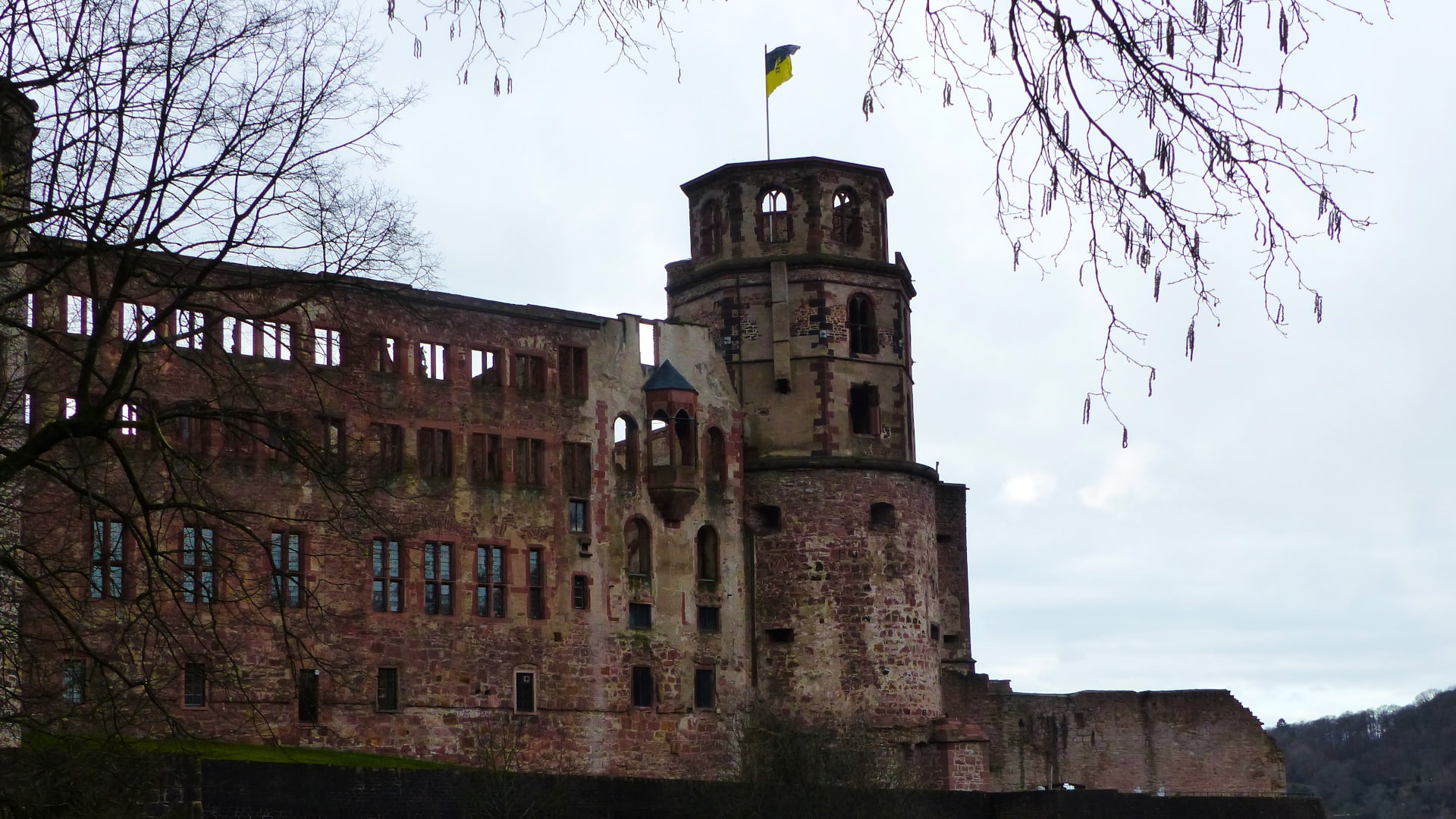
The Heidelberg Castle - what a place steeped in history - situated on a terrace of the Königstuhl above the Neckar. Its beginnings go back to the 13th century. Documents mention a castle which probably already existed under the bishops of Worms. In 1303 two castles are mentioned for the first time, an upper castle on the Kleiner Gaisberg near today’s Molkenkur and a lower castle on the Jettenbühl, the location of which is already attributed to that of today’s castle.
Subsequent electoral princes visibly expanded the castle as a fortress with representational character. Towers, walls and ramparts were to protect against attacks. The Ruprecht Building, the Library Building, the Ludwig Building and the Glass Hall were mainly used for representation and for the demonstration of power.
Elector Ottheinrich (1502 - 1559) had the Ottheinrichsbau built - an early renaissance building with a magnificent front. The castle thus became a palace. In the following years, the Friedrichsbau, the English Building and the Hortus Palatinus garden are built, among others. This park, laid out in three terraces, with its exotic plants, aberrations, grottos and pleasure houses, was considered the “eighth wonder of the world”, but was never fully completed.
The political entanglements and the Bohemian debacle of Elector Frederick V (1596 - 1632) and the resulting Thirty Years’ War did not bode well for Heidelberg, the palace and its rulers. Destruction and plundering of the town and surrounding villages, a considerably damaged castle and the loss of the electoral dignity were the result of his failed policy. In 1649 the son of Frederick V, Charles I Ludwig, moved into Heidelberg as the new ruler. In the Peace of Westphalia of 1648, the Electoral Palatinate was granted a new electoral dignity again, but with considerably fewer privileges. The Elector began to repair his residence, but for the time being there was no money for important new buildings.
Again political entanglements led to great disaster. In 1671, Elector Karl I Ludwig married his daughter Liselotte of the Palatinate to Philip of Orleans, a brother of the Sun King, Louis XIV, who registered his claim to the inheritance in 1685, when Elector Karl II, who had been in power in Heidelberg for some time, died childless. The War of Palatinate Succession broke out and French troops twice occupied Heidelberg and the castle. While some houses and parts of the castle were still spared during the destruction in March 1689, French soldiers did far more damage in 1693. Mines brought down towers and fortification walls.
The Heidelberg Castle never fully recovered from the destruction in the War of Succession. In the meantime Mannheim had been appointed the electoral residence city and the elector Carl Theodor conducted his official business from there. In 1764 all plans for a reconstruction were finally destroyed. A lightning strike caused a fire and caused further considerable damage. What remained of the former castle was a ruin left to itself, at best still used as a supplier of high-quality building materials.
The castle ruins became world-famous due to the romanticism that arose at the beginning of the 19th century. After the university was re-founded in 1803, Heidelberg experienced a second heyday and attracted students and young artists from all over Germany. They described the destroyed castle as a symbol of German history and immortalized the building in their paintings, romantic stories or verses. The most famous names from this period are Carl Philipp Fohr, Karl Rottmann and Ernst Fries, Achim von Arnim, Clemens Brentano, Friedrich Hölderlin and Joseph von Eichendorff. Even Johann Wolfgang von Goethe raved about the ruins, the city and the landscape in his diaries, notes and sketches.
Of all people, a Frenchman, the emigrated Count Charles de Graimberg (1774 - 1864), became the saviour of the castle ruins. He was the first to make an effort to preserve the ruins. Graimberg documented the castle in numerous detailed drawings and his art collection later formed the basis of the Kurpfälzisches Museum.
Location & Directions
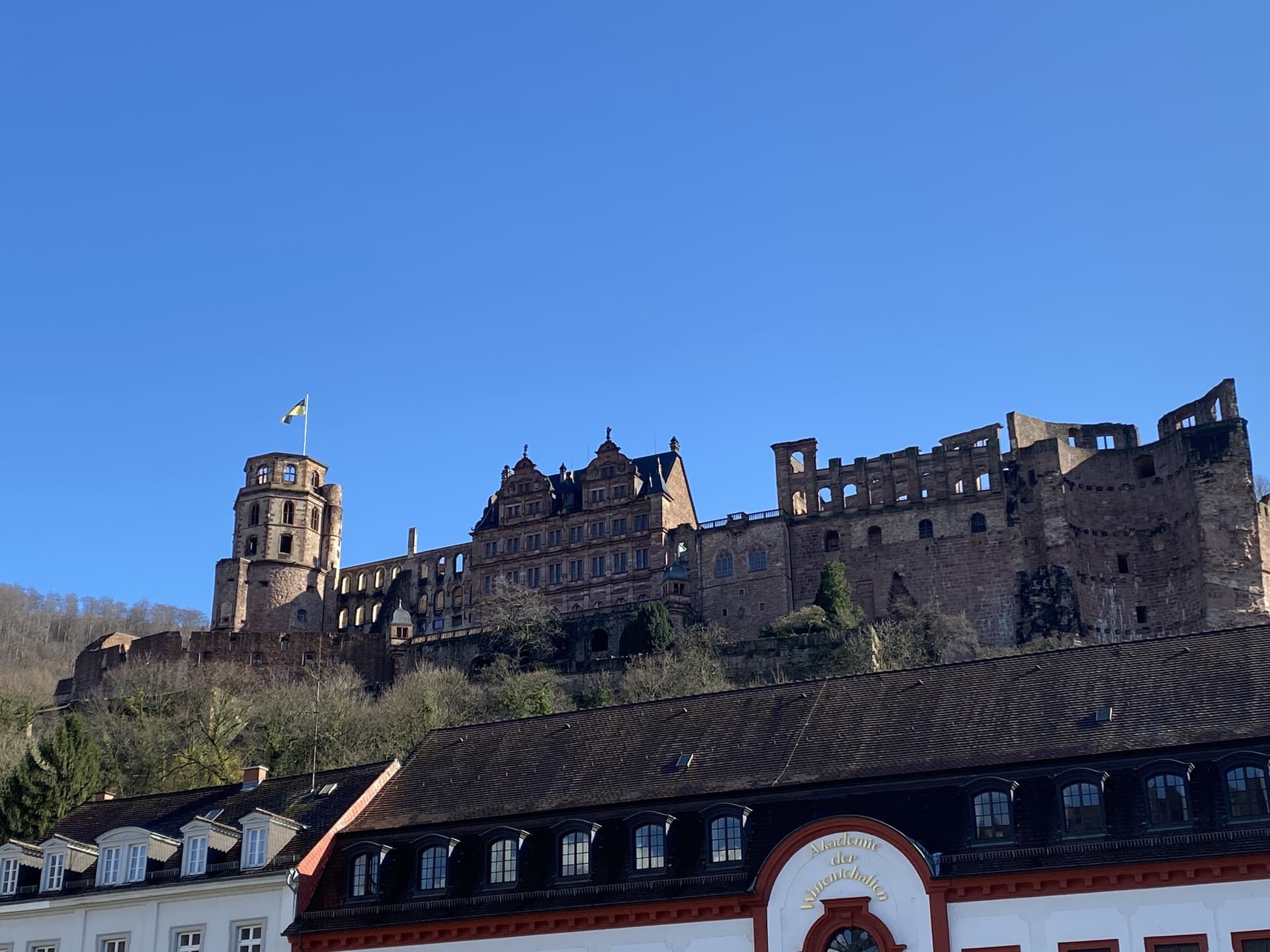
The Heidelberg Castle towers above the Old Town and can be viewed in its full size especially from Karlsplatz.
If you want to go up to the castle, there are several possibilities. You can drive to the castle by car or take the mountain railway at Kornmarkt to start your way to the castle. If you are fit, there are several possibilities to get to the castle by foot. If you pass the car park P12 at Kornmarkt on the left, you have two possibilities to start the ascent to the castle. Either, one climbs more than 300 stairs to the castle and gets straight to the part of the castle where the visitor center is located. Or one walks a steep path up to the castle and either gets straight to the castle or to the castle garden that offers a fantastic view over Heidelberg.
If you travel to Heidelberg by public transport and would like to visit the castle, it is best to get off at the Heidelberg-Altstadt suburban train stop. From there it is only a few minutes to Kornmarkt if you want to take the mountain railway. If you prefer to walk, you can take the first turn left into the street Friesenberg when you arrive in the Hauptstraße.
If you come by bus, the bus stop Rathaus-Bergbahn is located directly at the mountain railway, where you can get off. 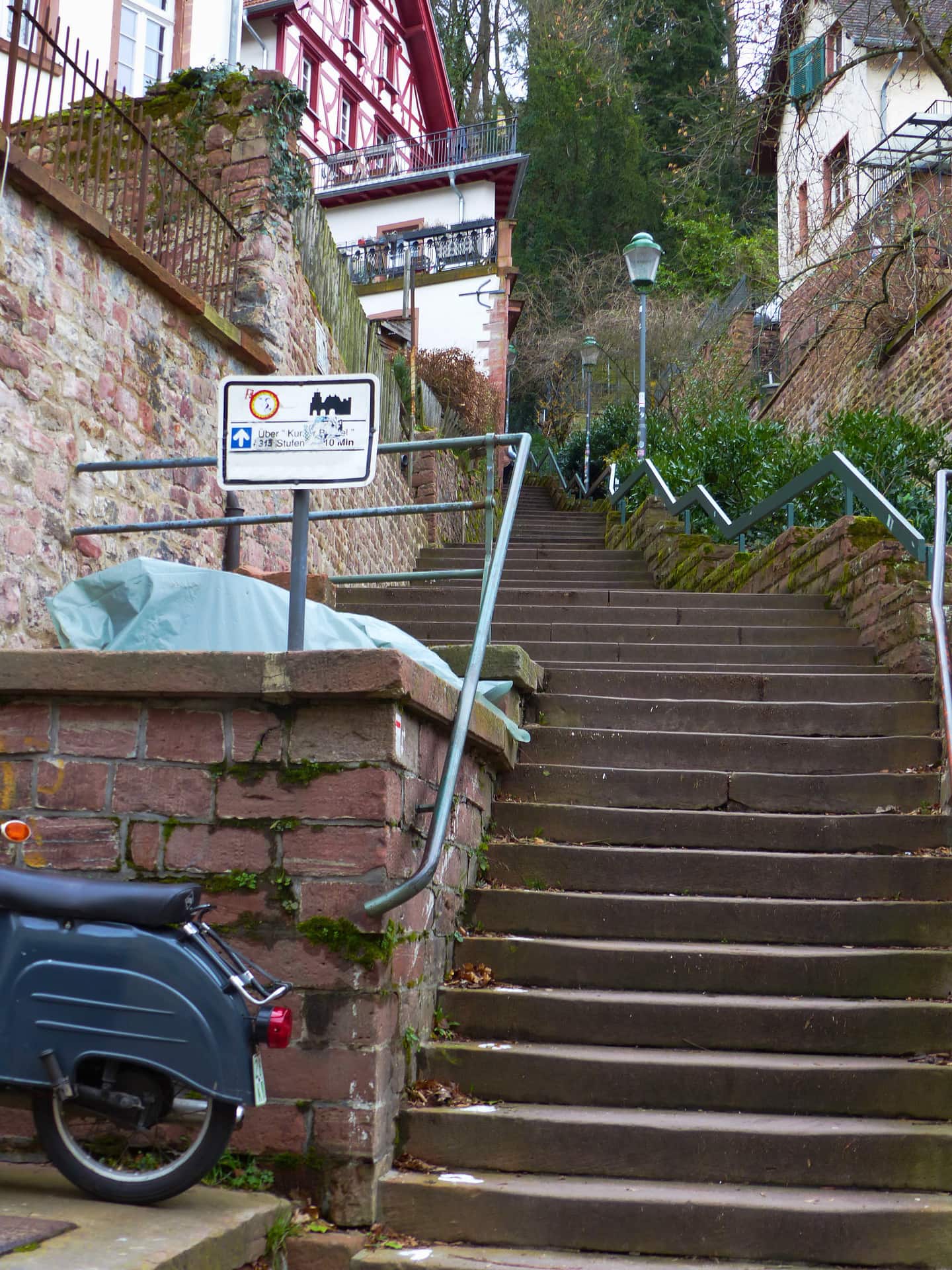
Planning your visit
The castle sits on a terrace of the Königstuhl directly above the Altstadt, Heidelberg’s Old Town, so a visit slots naturally into a day spent in the historic center. Most people underestimate how much there is to see once they are up there and end up rushing. Half a day is a comfortable amount of time for the courtyard, the terraces and the gardens.
Getting up to the castle
There are three sensible ways up, and they suit very different visitors.
The funicular. The easiest option by far is the Heidelberger Bergbahn, the historic funicular railway. It starts at Kornmarkt in the Old Town and has its own stop at the castle on the lower section, before continuing up toward Molkenkur and, with the upper line, all the way to the Königstuhl summit. If you are traveling with kids, with luggage or with anyone who would rather not climb, take the funicular.
On foot up the stairs. From Kornmarkt you can climb more than 300 steps straight up to the part of the castle where the visitor center is. It is a short, steep and genuinely tiring shortcut, and it deposits you at the entrance in well under 15 minutes if you keep moving.
On foot up the Burgweg. The Burgweg is the steep paved lane that switchbacks up from the Old Town. It takes longer than the stairs but the grade is more even, and it brings you either to the castle itself or to the castle garden, where the terraces open onto one of the best views over Heidelberg and the Neckar valley.
Arriving in Heidelberg
If you come by regional train, get off at the Heidelberg-Altstadt station rather than the main station. From there it is only a few minutes on foot to Kornmarkt and the foot of the funicular. Coming by bus, the Rathaus-Bergbahn stop is right at the funicular’s lower station. Driving up is possible, but Old Town parking is limited and expensive, so most visitors park once and walk.
Tickets and tours
Ticket types, guided tours and combined tickets for the castle change from season to season, so the honest advice is to book from a live inventory rather than trust a number printed on a travel page. The booking widget further down this page pulls current tours, entry tickets and skip-the-line options for the castle directly from the provider, including the guided walks that start in the Old Town and end at the castle.
What to see once you are inside
The courtyard is the heart of it, ringed by the Ottheinrichsbau, the Friedrichsbau and the remains of the Ruprecht Building. Below the castle spread the terraces of the Hortus Palatinus, the garden that was once called the eighth wonder of the world and was never finished. Inside the cellars stands the Great Tun, a giant wine barrel built in 1751 with an original capacity of 221,726 liters, roughly 58,500 US gallons. The castle also houses the Deutsches Apothekenmuseum (German Pharmacy Museum), which is a much better rainy day option than most visitors expect.
The best view of the castle is not from the castle
Worth knowing before you plan your day: the classic postcard view is of the castle, not from it. For that you want the Philosophers’ Walk on the opposite bank of the Neckar, where the ruin, the Old Bridge and the Old Town line up in a single frame. A common way to split the day is castle in the morning, Old Town at midday, Philosophers’ Walk in the late afternoon when the sun hits the red sandstone.
Several times a year the ruin is bathed in red light and a fireworks display goes off over the river. Those evenings are the single most spectacular thing that happens in Heidelberg, and the dates are worth checking before you book: see the Heidelberg Castle Illumination.
Impressions
Tours & Tickets
Tours & Tickets nearby
Guided tours and entry tickets around The Heidelberg Castle - book directly.
* Tours & tickets by GetYourGuide. If you book through the markers, we earn a commission at no extra cost to you.