
Sights
Heidelberg Bergfriedhof (Mountain Cemetery)
The Bergfriedhof in Heidelberg is more than a cemetery - it is a historic park and the city's largest open-air history book. More than 13,000 figures from science, politics and culture have found their final resting place here, among them Friedrich Ebert, Robert Bunsen, Max Weber and Carl Bosch.
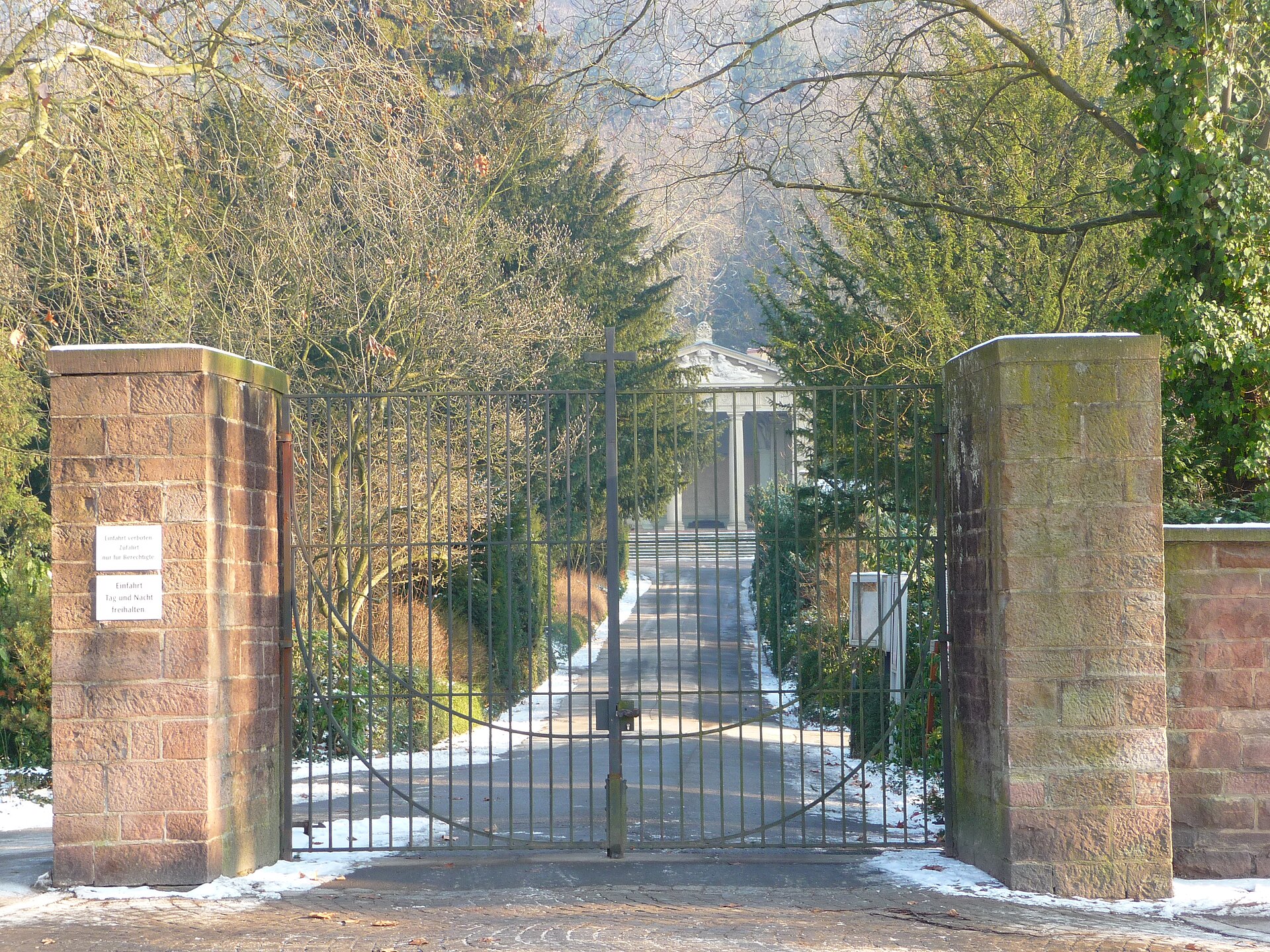
The site and its location
The Bergfriedhof covers around 14 hectares on the western slope of the Königstuhl, south of the Old Town. It opened in 1844, when the inner-city graveyards at St. Peter’s Church and the Church of the Holy Spirit had reached their capacity. That makes it one of the oldest municipal park cemeteries in Germany - planned not as a burial ground alone, but as a landscaped site with avenues, viewing benches and mature trees.
Today the Bergfriedhof ranks among the most important historic cemeteries in Germany. It is a listed monument and is maintained by the city of Heidelberg. More than 30,000 burials have taken place here; around 13,000 graves still remain.
Famous figures
The Bergfriedhof is the resting place of many people who shaped Heidelberg and German history:
- Friedrich Ebert (1871-1925), first President of the Weimar Republic
- Robert Bunsen (1811-1899), chemist and inventor of the Bunsen burner
- Max Weber (1864-1920), sociologist and founder of interpretive sociology
- Carl Bosch (1874-1940), chemist and Nobel laureate, co-inventor of the Haber-Bosch process
- Gustav Kirchhoff (1824-1887), physicist and co-founder of spectral analysis
- Hermann von Helmholtz (1821-1894), polymath and physiologist
- Wolfgang Windelband (1848-1915), philosopher of the Southwest German School
A detailed list with a site plan is displayed at the entrance, and selected graves are signposted.
Architecture and sculpture
Many of the graves are works of art in their own right. Walking along the main avenue you will find mausoleums in the Classicist style, cast-iron grave crosses from the 19th century, Art Nouveau sculptures and Expressionist headstones from the 1920s. The oldest surviving monuments date from the 1840s.
The crematorium deserves particular attention. Built in 1903 in Romanesque-revival forms, it is still in operation today and was one of the earliest crematoria in Germany.
Park character and planting
The Bergfriedhof is a botanical highlight. More than 320 species of tree grow here, including mighty plane trees, oaks, chestnuts, giant sequoias and rarities such as the ginkgo. The paths wind along the hillside and open up viewpoints over the city again and again.
Rhododendrons and magnolias bloom in spring; in autumn the foliage turns every shade imaginable. Walkers often use the cemetery as a quieter alternative to the Philosophers’ Walk.
Getting there and opening hours
The main entrance is on Rohrbacher Straße / Steigerweg in the Südstadt district. From the main station, tram line 5 runs directly to the “Bergfriedhof” stop. Coming from the Old Town, take bus line 33 or walk via the Friedrich-Ebert-Anlage (about 20 minutes).
The cemetery is open daily:
- April to September: 7:00 to 20:00
- October to March: 8:00 to 18:00
Admission is free. Dogs are permitted on a lead only.
Guided tours
The city of Heidelberg and the Bergfriedhof support association regularly offer free themed tours, for example on “Scientists at the Bergfriedhof” or “Friedrich Ebert and the Weimar Republic”. Dates are published by the Heidelberg tourist office.
Tours & Tickets
Tours & Tickets nearby
Guided tours and entry tickets around Heidelberg Bergfriedhof (Mountain Cemetery) - book directly.
* Tours & tickets by GetYourGuide. If you book through the markers, we earn a commission at no extra cost to you.